
What’s a VPP? Our explainer
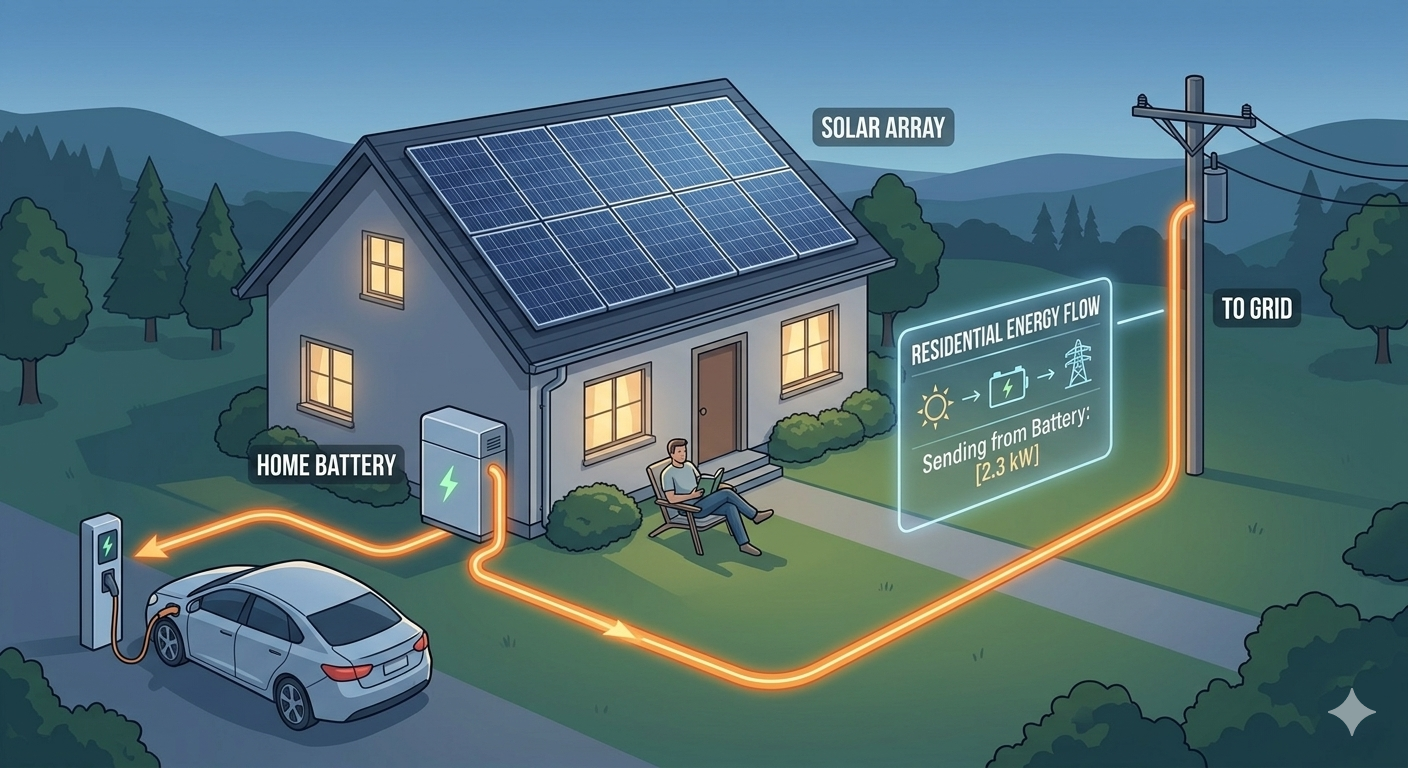
Virtual power plants (VPPs) are essentially a group of home batteries charged from predominantly rooftop solar (AKA solar battery) coordinated through hardware and software to act as one. It is the definition of power in numbers. Power for what though, you might ask?
Around 1 in 16 Australian homes now have a solar battery, reflecting the rapid uptake since the federal government's Cheaper Home Battery scheme was introduced. When you join lots of smaller batteries localised around communities, you are creating a unified decentralised energy network. As an aggregate, a VPP becomes a coordinated entity large enough to buy and sell electricity in the wholesale electricity market. This gives everyday households the opportunity to capitalise on one of the largest connected grids and most volatile electricity markets in the world, the National Energy Market (NEM), which spans SA, Tas, Vic, NSW and Qld. There are varying degrees of bidding and trading strategies, but we can leave that to the market analysts to figure out.
What it means though is that someone smarter than most of us are able to buy and sell your electricity in a market to make money or reduce electricity bills, it sounds pretty good, right? In theory, yes. Companies like Amber have been leading the way in this space, and larger retailers like AGL and Origin also offer VPP participation. Now, as soon as you heard those retailer names there was probably a little skepticism. And rightly so, since these retailers are in business to make money.
it is important to do some homework, as there are many variations of VPPs offered by a number of retailers. Some, like Amber, allow access to buy and sell on the wholesale market for electricity. In this case software can automatically buy and sell electricity on your behalf - you can use automated settings or manually mange things. Beware here - there are both risks and opportunities as prices can be volatile. In other VPPs, the retailer sets basic pricing and rules and carries the risks - reducing both consumer risks and opportunities.
Different to VPPs, there are also a small number of ‘virtual energy networks’, or VENs, allowing buying and selling to specific sites with or without solar or batteries based on smart meter or battery ID’s These are mostly available to larger commercial customers. At the time of writing, the retailer Energy Locals is one retailer that offers a VEN to residential customers on a specific plan.
But back on our main topic of VPPs; there are some important questions worth asking before joining a VPP.
Most VPPs run by retailers have an energy plan attached - how does this compare to what you are currently paying?
What control will you have, especially, how low will they run your battery, and when?
How often will they cycle it?
How complex is it? Do you want to be hands on, or keep it simple and be hands off? and
Who benefits most from the arrangement?
In order to join a VPP, you will need to meet the network provider's criteria for their VPP. These are likely to include not just the need to have a home battery of a minimum size, but also the make and model, in order to check if it can be controlled by the network provider. There is possibly also a minimum size of each rooftop solar system, as well as location criteria and a good internet connection.
Do your research and find a VPP that aligns with how you want your battery to be used, there are certainly some promising options out there that can improve the payback time on your investment in a home battery.
VPPs have the potential to unlock decentralised electricity systems that keep more of our energy local, save money and make the grid much more efficient.
